There Is No Parent Layer
AI governance has seven different jobs. A restaurant kitchen explains why none of them is the boss of the others.
- Author
- Sushee Nzeutem, SVRNOS
A customer gets food poisoning at a good bistro on a Friday night. By Monday, seven people are asking seven different questions.
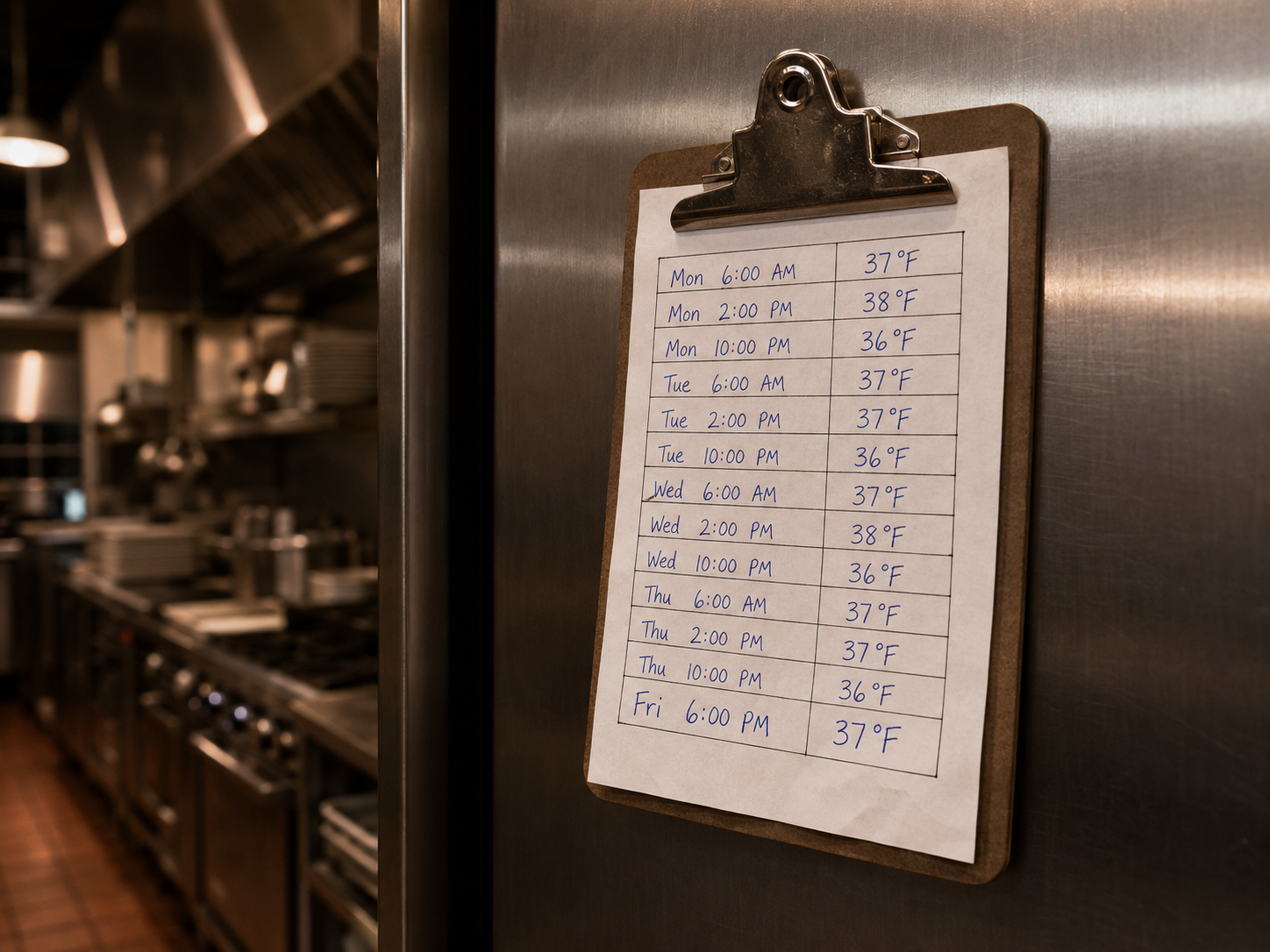
The chef wants to know which station failed: the fridge, the prep counter, the grill, the pass. The health inspector writes a violation code on a form: not an essay, a numbered code that means “cold food held above 5°C.” The lawyer asks for the fridge log: the temperature record, written at 6 p.m. Friday, before anyone knew there would be a problem. The owner asks who was responsible for that fridge. The menu consultant asks whether the menu still makes sense now that the fish supplier changed. The insurer asks whether the whole chain held, from the delivery truck to the plate. And the security consultant asks a darker question: could someone have done this on purpose?
Seven questions. One incident. Now try the sentence that started this article.
Imagine the menu consultant standing up at the Monday staff meeting and announcing: “The Menu™ is upstream of the Fridge™ Log™.”
In a kitchen, everyone laughs. The fridge log has never needed a trademark. It has the temperatures. In AI governance, people say it with a straight face, in public, weekly. In the week after SVRNOS published its three artifacts, the same message kept arriving from framework authors: where does my work sit relative to this stack? The collaborative ones settled in two comments. The rest reached for vertical words: upstream, parent, the layer above the layers.
This piece is the placement test that settles it, with the kitchen along for the whole ride.
The placement test
To place a governance framework, ask which question it answers. Not how important it sounds. Which question.
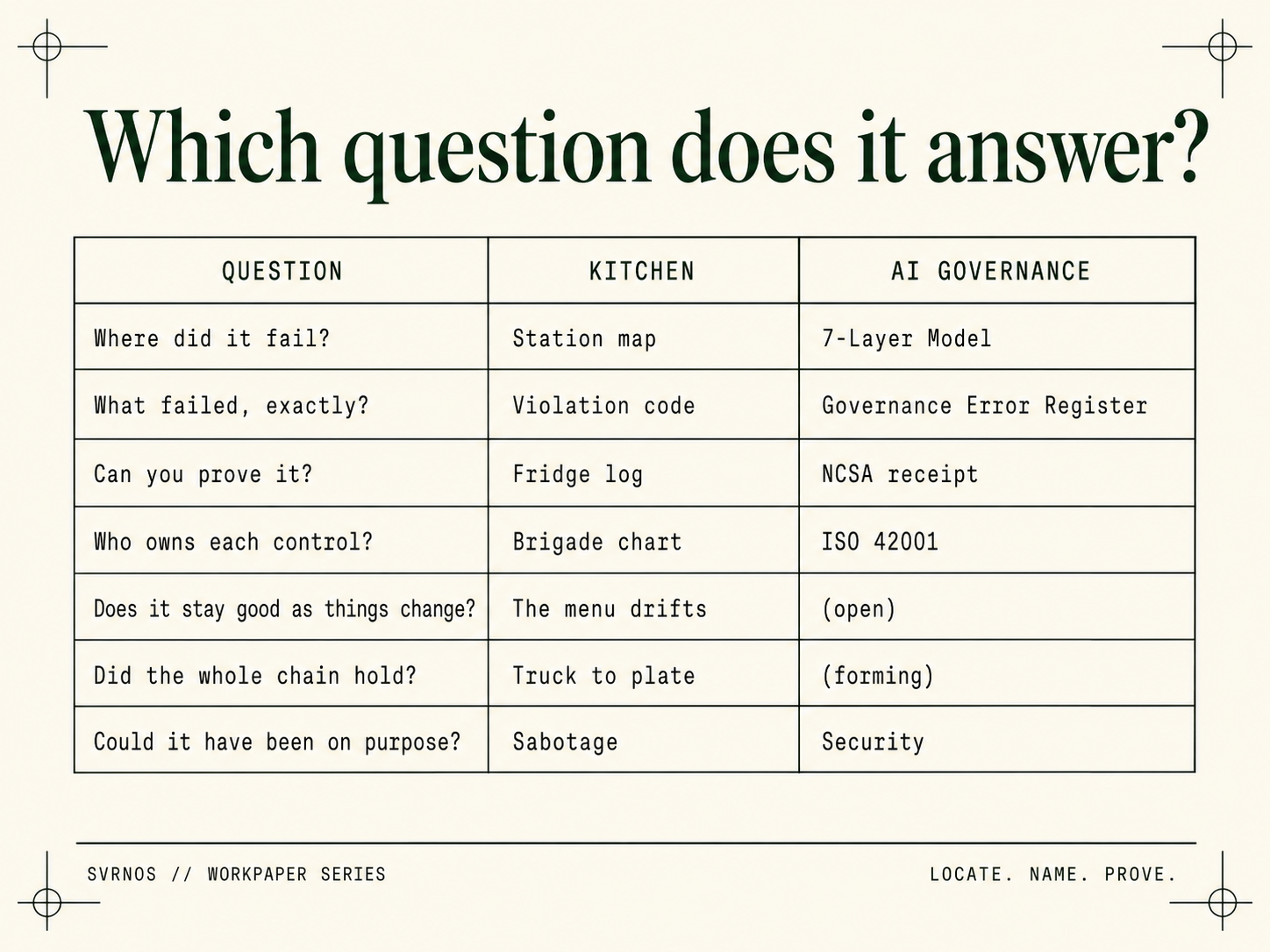
Where did it fail? The kitchen has a station map: fridge, prep, grill, pass. AI governance has the 7-Layer Model: seven layers from the compute the system runs on (L1) to the screen where enforcement reaches the user (L7). A location question.
What failed, exactly? The inspector does not write “the vibes were off.” She writes a violation code, and every inspector in the country writes the same code for the same failure. AI governance now has the same thing: the Governance Error Register, 110 numbered failure codes. The bistro’s incident has a name in both worlds. A classification question.
Can you prove what happened? The fridge log was written Friday at 6 p.m., not reconstructed Monday under pressure. It records the temperature, the time, and who checked. It does not record the chef’s feelings about the chicken. The NCSA receipt is the same object for AI: a signed, timestamped record that the safety check ran and what it decided, with no transcript of the conversation inside it. An evidence question.
Who owns each control? The kitchen brigade chart says whose job the fridge is. Organizations have ISO 42001 and their operating models. An ownership question.
Does the setup stay good as things change? The menu that worked in June fails in November when the suppliers change. Somebody has to watch that drift. A timing question, and in AI governance, mostly open territory.
Did the whole chain hold, end to end? Truck to fridge to prep to plate. Not one station: the route. A path question. Independent work is forming there.
Could someone attack it? Different question entirely, with its own discipline: threat modeling, OWASP MAESTRO on the AI side.
Seven questions. Every one of them necessary. None of them contains another. The inspector’s violation code does not outrank the fridge log. The brigade chart is not the parent of the station map. They answer different questions about the same Friday night, and the restaurant needs all seven answered.
That is the whole doctrine. The rest is what happens when people forget it.
The claims, kitchen-tested
The same sentences keep arriving in comment sections and DMs. Each one collapses the moment you walk it into the bistro.
”My framework is upstream of yours”
Kitchen version: “The menu is upstream of the fridge log.”
Upstream is a pipeline word. It means something flows through one thing before reaching the next. So ask the only question that matters: what flows? Flour flows from the mill to the bakery: the mill is upstream, the flour is the shared object. But nothing flows from the menu into the fridge log. The menu plans dishes. The log records temperatures. Different objects, no pipe.
Same in AI governance. A classification register processes incident reports. A receipt format processes execution events. An operating model assigns jobs to people. No shared object, no pipe, no upstream. The test: ask which of your objects passes through their framework first. When the answer is a subject change, the claim was marketing.
”Mine is the parent question”
Kitchen version: “Until you answer my menu-philosophy question, your fridge log means nothing.”
Parent means dependency: the child supposedly cannot work without it. So run the removal test. Fire the menu consultant. Does the fridge log stop working? Does the inspector forget her codes? Does dinner stop? Nothing breaks, so nothing was a parent. The hierarchy lived in the sentence and nowhere else.
Outputs can have dependencies. Questions have scopes. A framework earns the word parent only when another framework’s output cannot be produced without it, and that is a property you can check rather than a sentence you can claim.
”Your map is missing the layer that decides”
Kitchen version: “Your station map forgot the moment the dish is allowed to leave the kitchen.”
Walk to the kitchen. There is a station for that. It is called the pass, the chef stands at it, and every plate crosses it before it reaches the dining room. The map did not forget it; the visitor did not read the map.
The same claim arrived about the AI stack: “your layers are missing the decision boundary that authorizes action.” Walk to the spec. The boundary is there too: admissibility is resolved before the action commits, and re-checked at every crossing after. Same answer in both worlds: read the map before reporting a hole in it.
A claimed gap can also be real. A guest asks who tracks allergy warnings, and the kitchen discovers it has no log for that. The right response is the opposite of defense: add the log and thank the guest. The attestation spec keeps a list of exactly such gaps, its open-questions section, and the readers who found them are named in it.
”We already follow the food code. Why your map?”
This one deserves a straight answer, because it is a real question and not a positioning move.
The food code tells the kitchen what should be true: hold cold food below 5°C. The violation code names what failed when it was not. The fridge log proves what the temperature actually was. Three documents, three jobs, zero conflict, and every functioning restaurant runs all three at once. Swap in NIST AI RMF for the food code, the register for the violation codes, the receipts for the log: the sentence survives unchanged. The details differ between the two worlds; the separation of jobs does not.
The test for this one: a framework that asks you to replace your existing stack is claiming to answer every question at once. Composition never requires renegotiating your compliance posture. Replacement always does.
”So which framework wins?”
In the bistro: does the station map beat the fridge log? The question embarrasses itself on contact.
Competition is real only between two frameworks answering the same question differently, and there it is healthy: compare and pick. Between different questions, nothing is being contested except the word governance, and the word does not need an owner.
The inspector does not care about your philosophy
Here is where the kitchen stops being a teaching device and becomes the actual point.
When the inspector arrives, she asks three questions: which station, what violation, show me the log. In SVRNOS terms: location, classification, evidence. A restaurant that answers “our holistic culinary governance covers all of that” fails the inspection, because “all of it” cannot be checked.
AI procurement is heading the same way. The buyer who already runs NIST and ISO does not want a metaphysical hierarchy of frameworks. She wants the vendor’s layer, its failure modes, and its evidence. A vendor stating those three things is asking for a purchase order. A vendor claiming to be the layer above everything is asking the buyer to renegotiate her compliance posture, and she will not.
Place yourself
None of this is novel, and that is the point. Kitchens have kept fridge logs for generations. Medicine has coded its failures since before ICD-10 had a number. Banks have kept records that bite since the Bank Secrecy Act. The boring machinery is the proven machinery, and the three SVRNOS artifacts cite their ancestors on the first pages. The only new work is building the same discipline for AI. The fastest way to spot a menu consultant is the claim that any of it needed inventing.
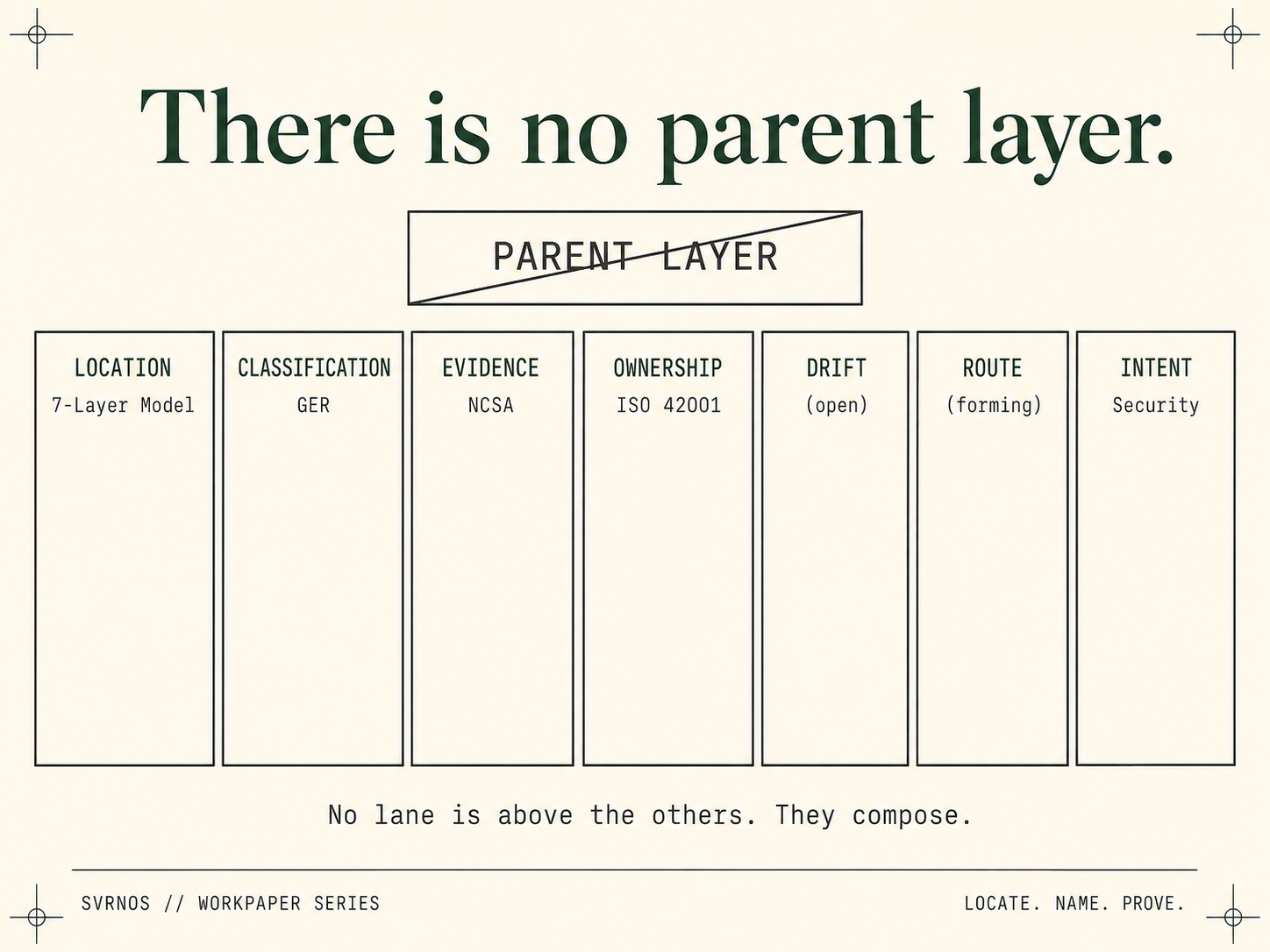
The map is CC BY 4.0. Placement is self-service: name the question your framework answers. If it answers a question this stack does not, the lanes compose, the way the ownership, timing, and route lanes already do. If it answers one of the same three questions differently, compare answers in public. Both outcomes move the field.
Where did it fail. What was it. Show the log.
Locate. Name. Prove. Composition is the operating rule, in the kitchen and in the stack.
Place your framework. The 7-Layer Model is CC BY 4.0 and placement is self-service: name the question your framework answers. The regulatory lineage table shows thirteen frameworks already placed, none displaced.