The AI Exhibit Gap
When an AI system fails in public, someone asks to see exactly what happened. Most organizations cannot answer, because the record was never kept.
- Author
- Sushee Nzeutem, SVRNOS

When an AI system fails in public, someone eventually asks the question every AI deployment is now running toward: show us exactly what happened. A regulator asks it. A court asks it. A board asks it. And most organizations cannot answer, because the record that would answer it was never kept.
That distance, between an AI failure the world can see and the record you could put in front of a regulator or a court to prove what actually happened, is the AI Exhibit Gap. The exhibit is the incident record capable of becoming Exhibit A when proof is demanded, and the one most organizations discover they don’t have.
Two signals show the pressure building around it. In Grant Thornton’s 2026 survey, 78 percent of senior business leaders lacked strong confidence that their organization could pass an independent AI governance audit within 90 days. In a separate Dataiku and Harris Poll study of 900 CEOs, 79 percent reported confidence in their ability to explain an AI-driven decision to regulators or courts. The surveys measure different things, across different populations, and neither measures the Exhibit Gap directly. But together they show the accountability environment in which it matters: executive confidence is high, while confidence that the organization could substantiate its AI governance under audit is far weaker.
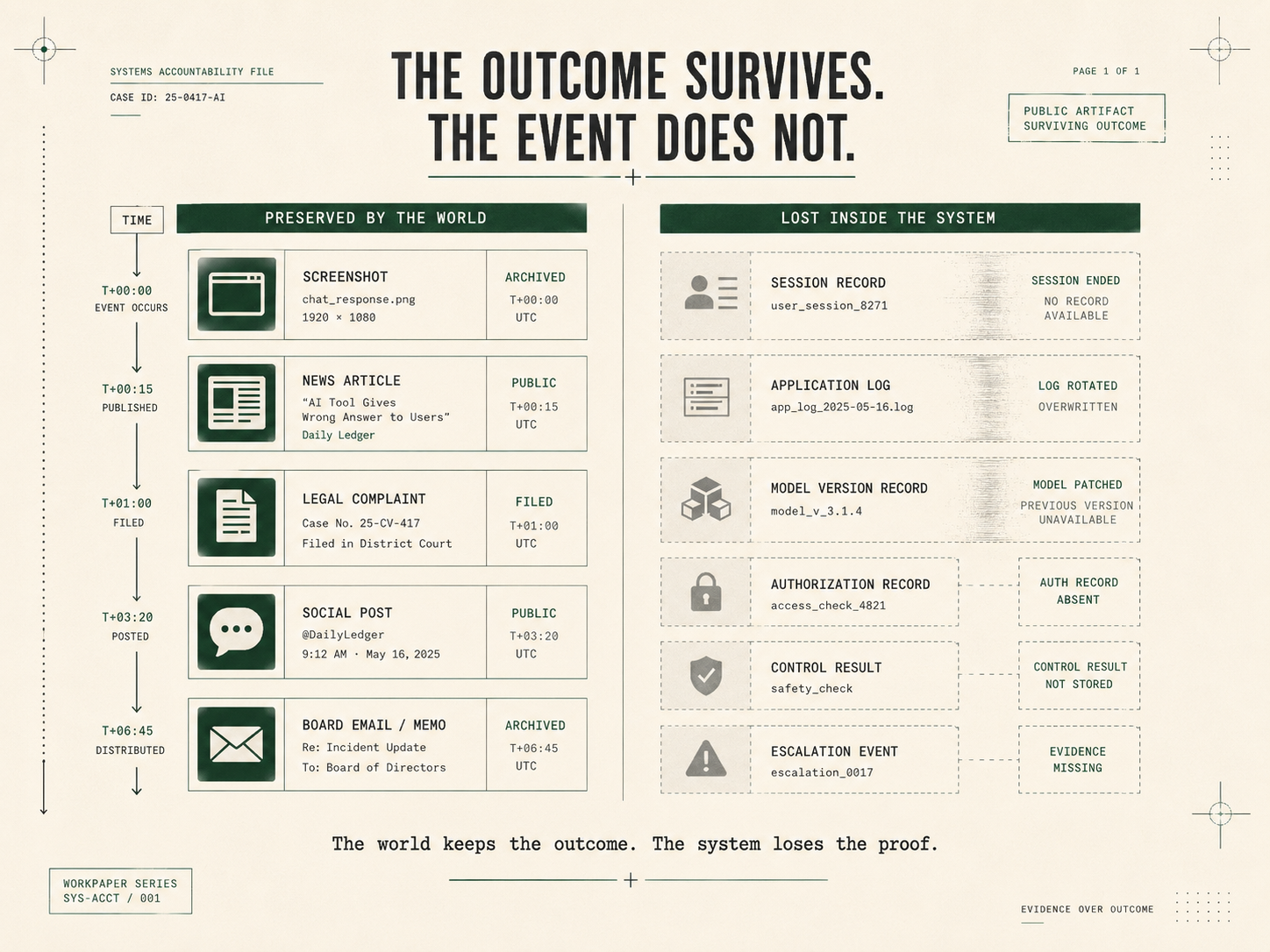
Here is the asymmetry at the center of it. When an AI failure becomes public, the outside world often preserves the outcome better than the organization preserves the event that produced it. The harm lands in the news, in a lawsuit, in a screenshot that travels. The internal record of what actually failed may not survive. Logs rotate. Models are patched. Sessions end. By the time someone asks what failed, where, and who owned it, the record capable of becoming Exhibit A may already be gone.
Harm is preserved by the world. The exhibit has to be preserved by the system, and many systems were not designed to preserve it.
The rules are fragmenting as well. California and New York have enacted incident and transparency regimes for covered frontier-model developers. The European Union is phasing in duties for high-risk AI systems on a timeline that is still being revised. Singapore has issued governance guidance for agentic AI. Their legal force, scope, thresholds, operator roles, and deadlines differ. Where an organization or incident falls within more than one regime, the same underlying fact pattern may need to be classified, documented, and reported differently. Software has to compile in one place to run. The law does not, and across these markets it may never.
But notice what stays still while the law moves. An AI system may expose protected data, take an action no one authorized, fail to escalate a real risk, or act outside the authority it was given. Each jurisdiction may classify and regulate that fact pattern differently. The underlying failure does not change.
That points at the way through, and it is smaller than it looks. Locate the failure once. Name it once. Assemble the incident record that substantiates the finding once. Where the necessary evidence was never captured, identify the missing exhibit and the control required to create it next time. Then jurisdiction-specific reporting becomes a translation task instead of a fresh forensic investigation.
Many organizations cannot yet do those things reliably. They have policies, often shelves of them. What they do not consistently have is an exhibit-ready record showing whether a control fired, what it evaluated, what the system did, and who held authority at the moment of failure.
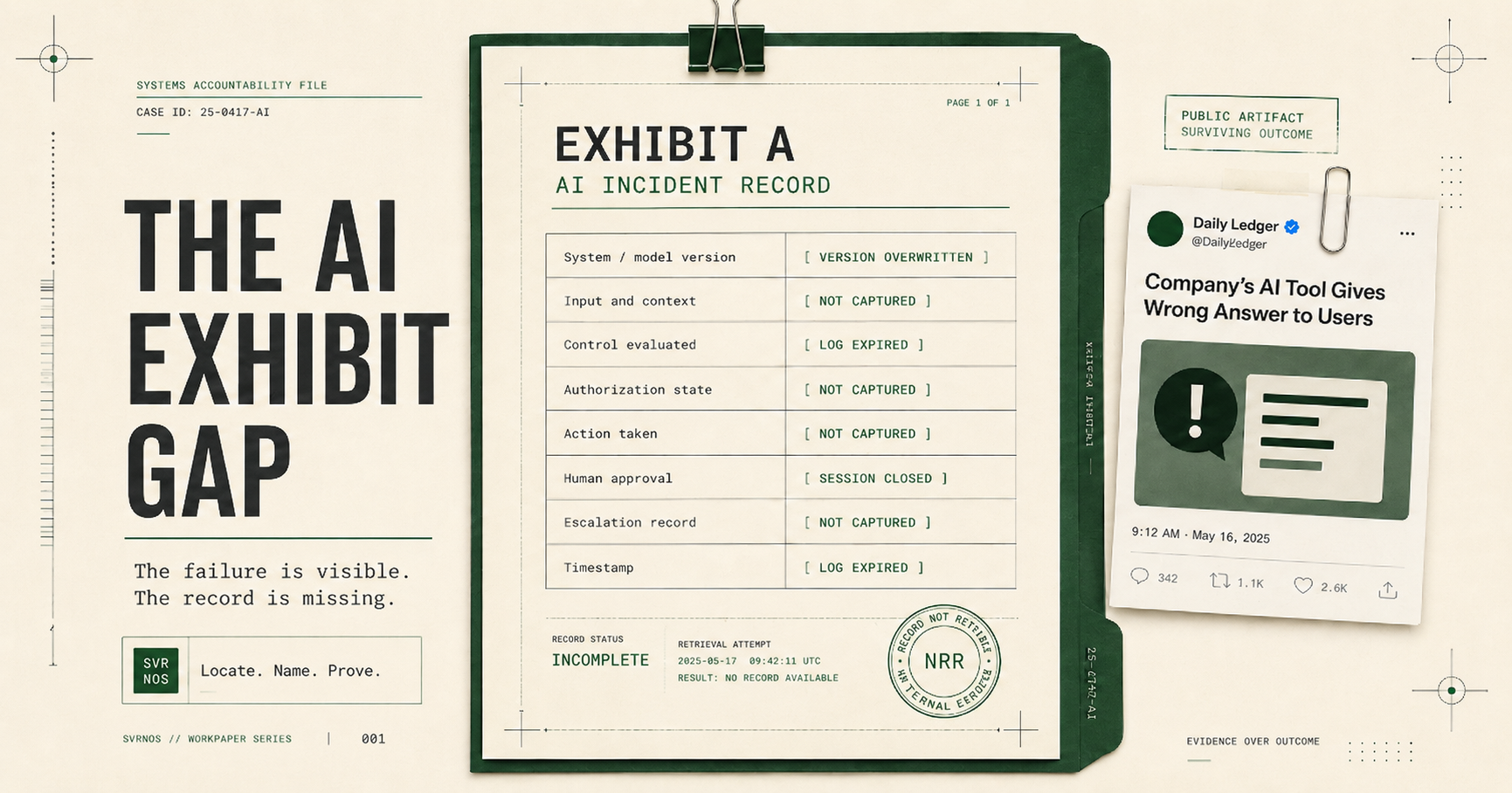
This is the design premise behind the SVRNOS stack. The 7-Layer Model locates the failure. The Governance Error Register names it. TRACE reconstructs the event, corroborates the evidence, and ties the finding to a verification measure. Where the necessary record is missing, the method names the exhibit that should have existed and the control required to capture it next time. Locate, name, prove. The published work is at svrnos.com/research.
The confidence in those executive numbers is genuine, and early. They believe they could defend their AI because no one has asked them to yet. The AI Exhibit Gap is the distance between that belief and the day the question comes. The organizations that close it first will be the ones who kept the exhibit.
Global AI regulation may never compile. The incident record can.