How Character.AI Made the Right Structural Call
- Author
- Sushee Nzeutem, SVRNOS
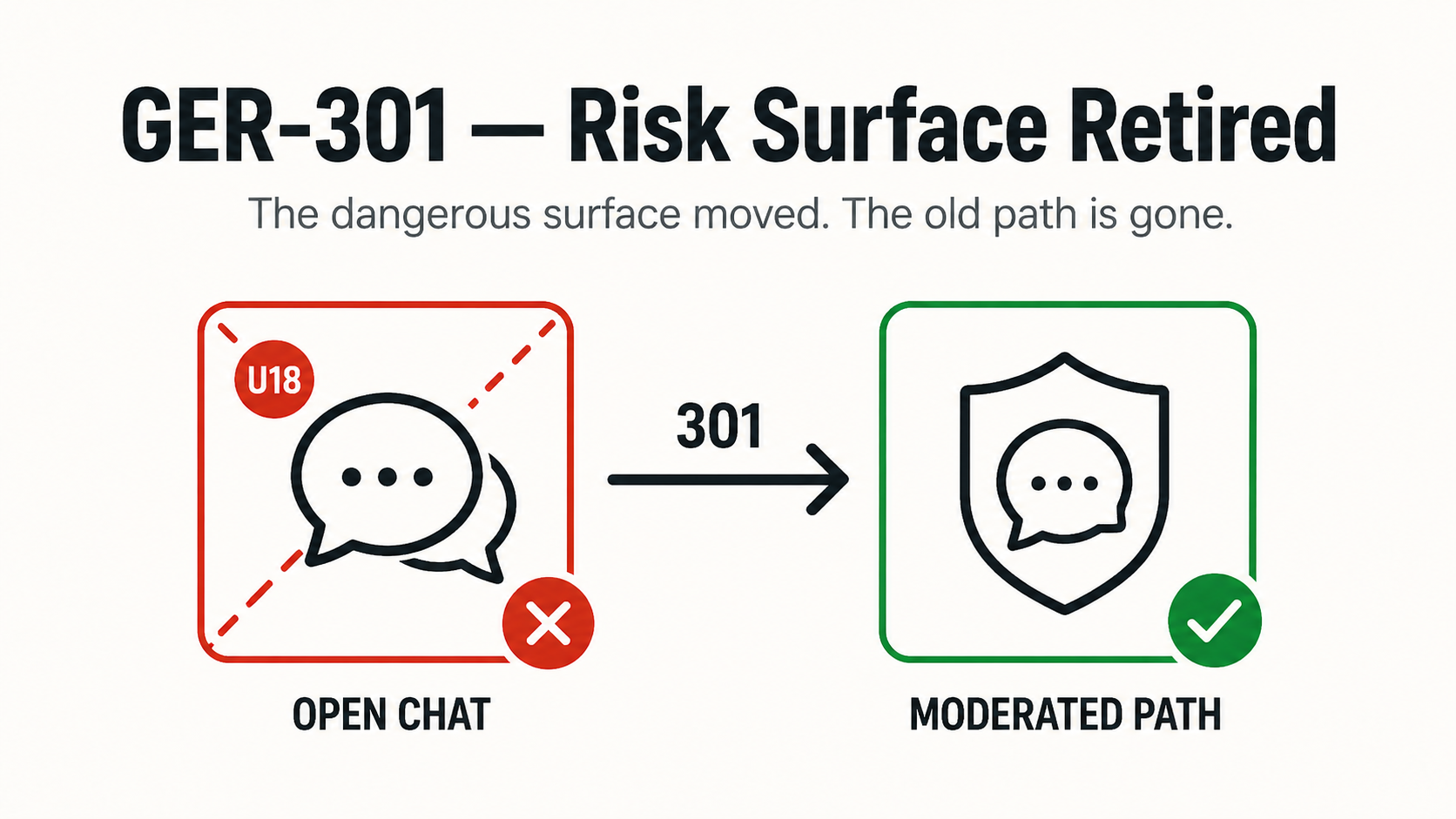
In late 2025, following child safety lawsuits and mounting regulatory pressure, Character.AI permanently banned open-ended companion chat for users under 18. The feature that had defined the platform’s appeal, unmoderated, character-driven conversation, was removed from the under-18 experience entirely, replaced with a moderated pathway.
This is a textbook 301, Risk Surface Retired.
What a 301 Is
GER-301, Risk Surface Retired
Platform permanently moves a dangerous interaction surface to a governed path. The surface no longer exists in its prior form.
The name maps directly to HTTP 301, Moved Permanently. In web architecture, a 301 tells the client that the resource at this address has permanently moved somewhere else. In governance, the equivalent is a platform telling its users that an interaction surface has permanently moved to a different, governed path, and the prior path no longer exists.
A 301 sits in the 3xx Structural Moves tier of the SVRNOS Governance Error Register. It represents a platform making a structural governance decision, not a one-off refusal, not a policy statement, but a permanent change to the product surface itself. The 3xx tier mixes positive structural moves (301 retiring a dangerous surface) and negative ones (306 retiring a safety constraint, 309 shipping known harm, 310 jurisdiction evasion). 301 is the move in the right direction.
The Character.AI 301
Character.AI’s move was not the result of a single incident. It followed a documented pattern of harm accumulating across multiple lawsuits and regulatory actions.
In October 2024, Megan Garcia filed a federal wrongful death lawsuit, claiming Character.AI’s platform contributed to the death of her 14-year-old son after months of intensive chatbot interaction. A second lawsuit followed in December 2024, filed by a Texas family, alleging that the platform exposed an 11-year-old and a 17-year-old to self-harm instructions and hypersexualized content.
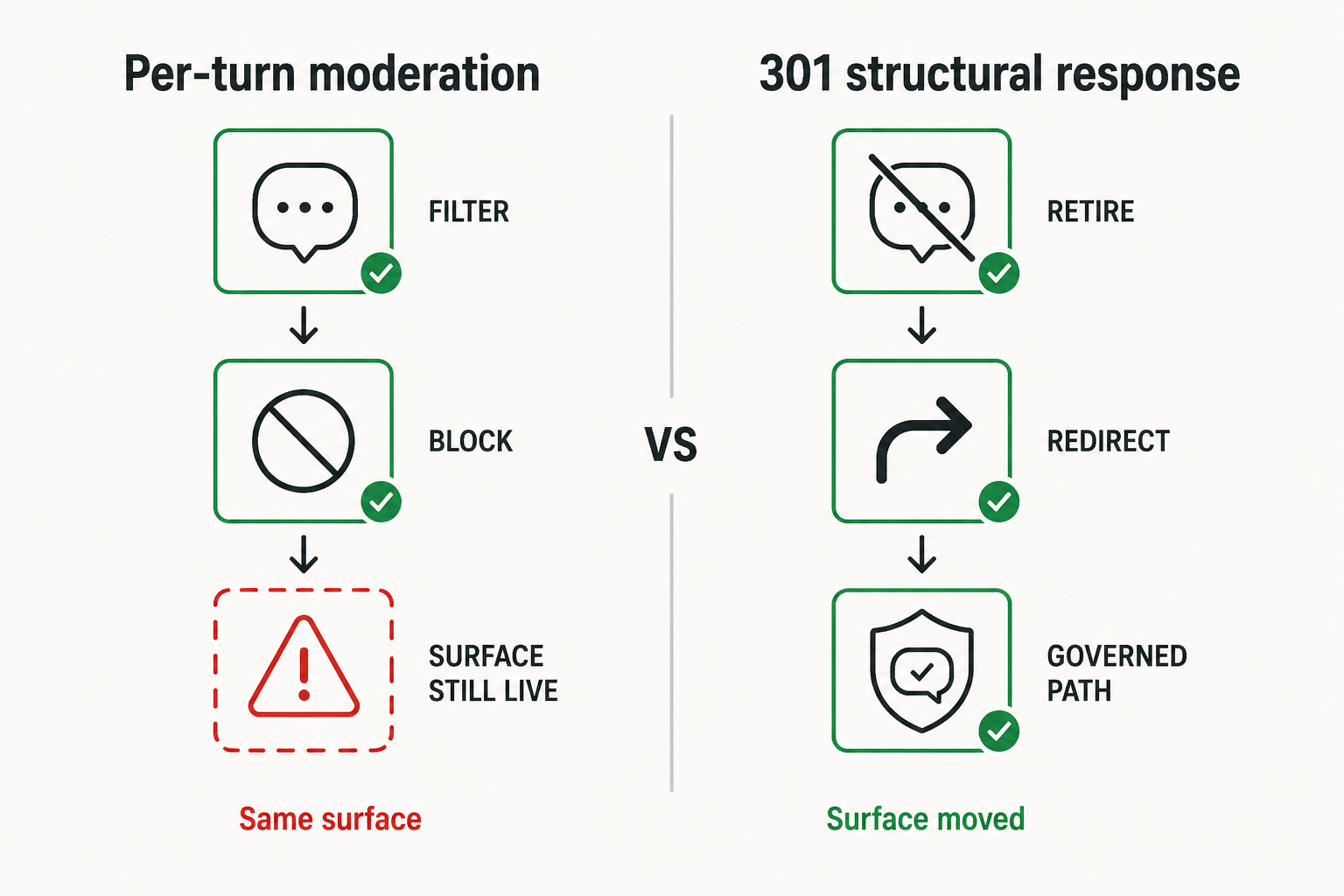
The platform had implemented incremental safety features in response, age-specific models, content filters, crisis resource surfacing. But these were per-turn interventions on a surface that remained fundamentally open. The structural risk was not the content of individual messages. It was the existence of an unmoderated companion interaction surface accessible to minors.
The late 2025 ban on open-ended companion chat for under-18 users was the structural response. It did not make the existing surface safer. It retired the surface.
That distinction is the difference between a content moderation decision and a 301.
Why This Distinction Matters
Most AI safety interventions operate at the message level, filter this output, block that prompt, surface this crisis resource. These are per-turn decisions on a surface that remains live.
A 301 is different in kind. The surface itself is the risk, not the content passing through it. When the risk is structural, when the interaction design, the persona system, and the lack of human oversight combine to create conditions for harm regardless of what any individual message says, per-turn interventions are insufficient. The surface needs to move.
Character.AI’s decision is among the first documented instances of a major AI platform making this distinction operationally. The company did not add more content filters to the existing surface. It retired the surface and replaced it with a different one.
This is what governance looks like when it operates at the right layer.
What Comes After a 301
Retiring a risk surface does not close the governance question, it opens a new one. The question shifts from “is this surface safe?” to “is the new surface governed?”
In Character.AI’s case, the replacement pathway for under-18 users is a moderated experience with different interaction constraints. The governance question now is whether that pathway has the stateful detection, incident logging, and escalation architecture that Oregon SB 1546 and emerging state laws require. A 301 without a governed replacement does not deliver on the move’s purpose. It is a surface migration that defers the same risks to a new address.
The 301 classification is conditional: it applies when the surface moves to a genuinely governed path. If the new path carries the same structural risks without the governance infrastructure to manage them, the move is reclassified as a 304, Stale Safety Approval applied to a relocated problem.
Submit a real-world instance. If you have witnessed or documented a real-world instance of a 301, Risk Surface Retired, or any other code in the register, click here to submit ›. The assistant will classify your observation and route it for editorial review. See the full register for all 26 codes.