The Resume Is No Longer Evidence
- Author
- Sushee Nzeutem, SVRNOS
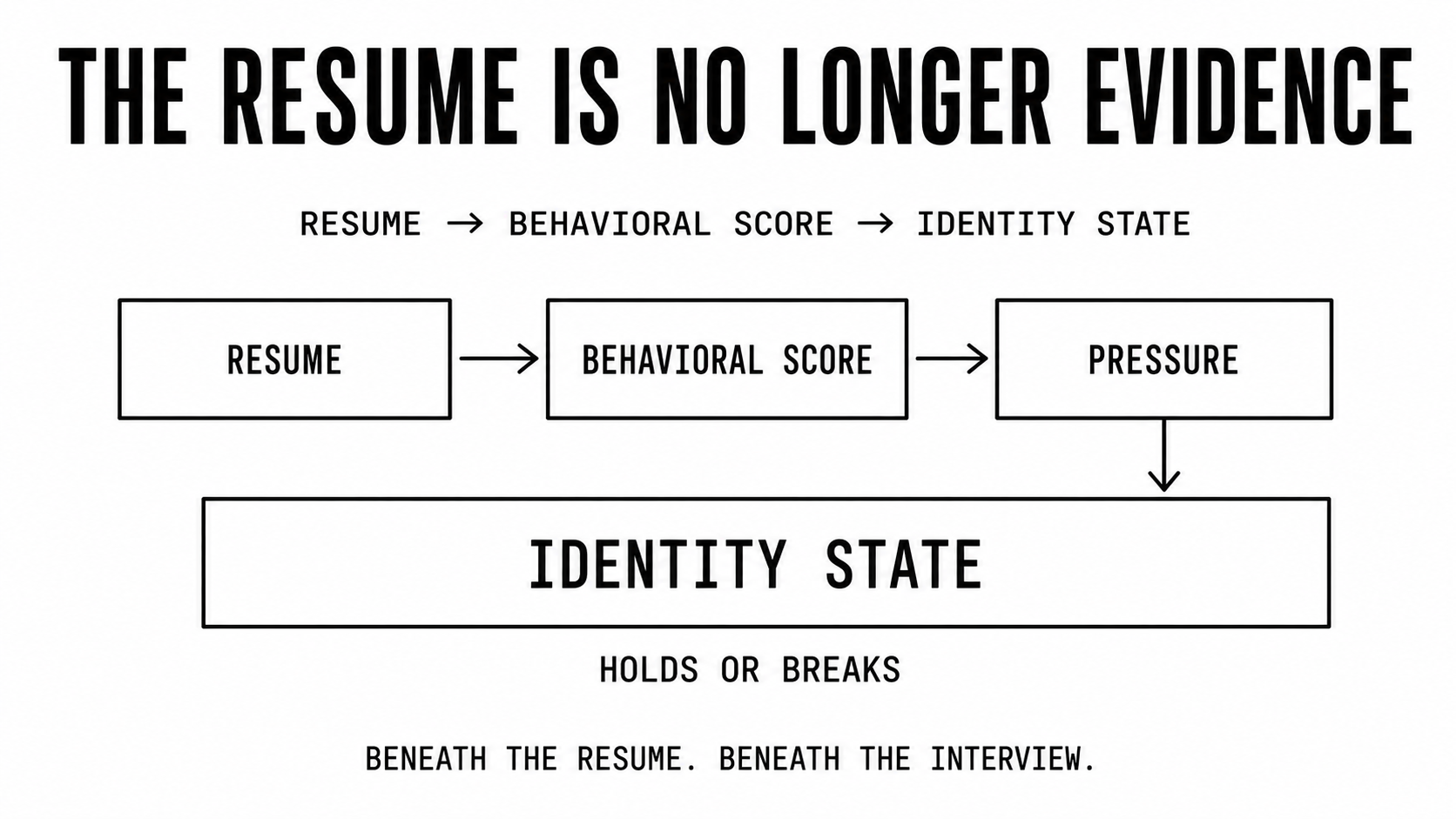
The resume is no longer evidence.
On April 28, Phenom acquired Plum and named the problem directly: AI-generated resumes, deepfake interview responses, and fabricated work histories have created a candidate verification crisis.
They are right about the crisis.
They are wrong about where it ends.
Phenom’s answer, like most of HR tech’s answer, is to add a behavioral science layer on top of the hiring funnel. Score for cognitive fit. Assess for job match. Validate what the resume can no longer prove.
That matters. It also reveals something larger: the industry has accepted that candidate self-presentation is no longer a reliable source of truth.
For decades, resume screening was the dominant paradigm. Then skills tests were supposed to fix the resume. Now behavioral diagnostics are becoming the fix for the fix.
That is the real signal inside the Phenom-Plum acquisition.
Hiring platforms are no longer just asking, “What has this person done?” They are moving toward a harder question: “Can we verify how this person actually behaves?”
But there is a limit to what hiring-context behavioral science can tell you.
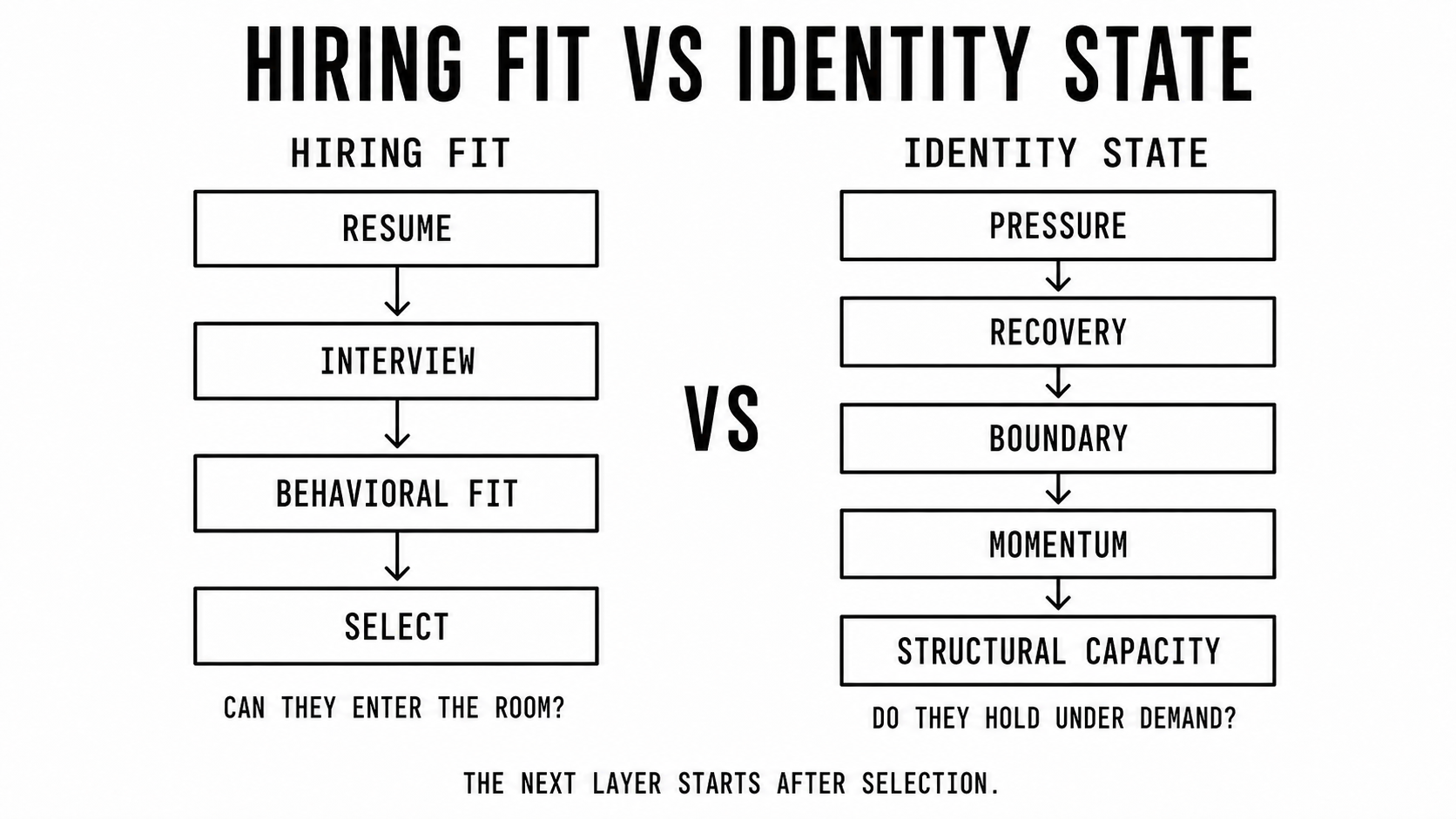
Most candidate assessments are designed to predict performance against a role. They are built around selection, fit, and job match. Their purpose is to help an employer decide whether someone should enter the room.
That is useful.
But it is not the same as understanding what happens to someone’s identity once pressure stops being theoretical.
A founder can pass a behavioral assessment and still collapse under investor pressure eighteen months later.
A partner can interview with extraordinary alignment and still drift when the market turns.
An executive can score perfectly on cognitive fit and still hit a boundary crisis when the mandate expands.
A cohort applicant can look high-potential during selection and still become unstable once intensity, ambiguity, and social pressure arrive.
These are not resume problems.
They are not skills problems.
They are not simply hiring problems.
They are operational identity problems.
The failure point is not always whether someone can perform under structured evaluation. The failure point is often whether their decision architecture holds under sustained pressure.
Do they recover or compensate?
Do they hold boundaries or overextend?
Do they gain momentum or fragment?
Do they stay coherent under demand, or does their operating system distort once the stakes rise?
That is the layer most hiring assessments were never designed to read.
SIM95 was built around that layer.
Not as a candidate filter. Not as another hiring test. Not as a replacement for behavioral science inside the funnel.
SIM95 reads the identity state underneath the performance: how someone organizes under pressure, where their collapse signature sits, how their emotional operating system handles constraint, and whether their momentum is stable, volatile, depleted, or performative.
The diagnostic captures dimensions hiring assessments usually do not model: recovery pattern, boundary level, momentum state, collapse severity, decision distortion, and structural capacity under demand.
That distinction matters.
Phenom bought Plum because behavioral truth is becoming a requirement in hiring.
That is the category forming.
But hiring is only the first surface.
The deeper question comes after the selection decision: whether the person, founder, executive, partner, or cohort member, is actually operating from the identity state you thought you were selecting for.
The market is learning that what people say about themselves is no longer enough.
The next layer is whether their structure holds when the room gets real.
That is where SIM95 sits.
Beneath the resume.
Beneath the interview.
Beneath the behavioral score.
At the level where performance becomes pressure, and identity either holds or breaks.