What the Musk-Altman Lawsuit Looks Like Before It Starts
- Author
- Sushee Nzeutem, SVRNOS
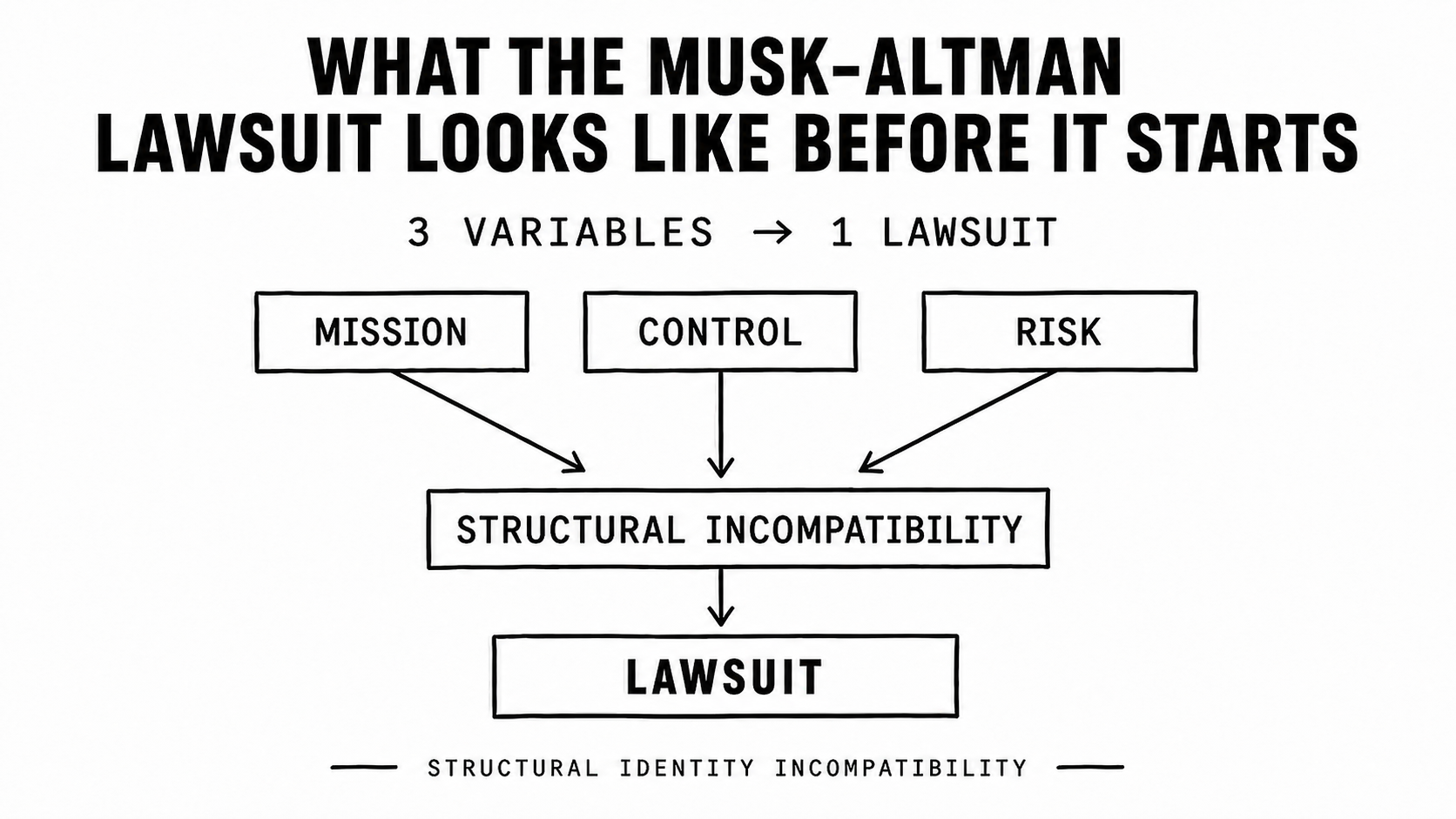
On April 28, 2026, Elon Musk took the stand in federal court in Oakland suing OpenAI and Sam Altman for $130 billion, alleging betrayal of the nonprofit mission he helped found. OpenAI’s defense was four words: “He didn’t get his way.” Both statements are true. Neither is the diagnosis. What happened between Musk and Altman was not a betrayal and not a tantrum. It was a structural identity incompatibility that was always going to produce this outcome, and it was measurable before Musk wrote the first check.
Three Variables, One Lawsuit
Co-founder conflicts are routinely described as personality clashes, strategic disagreements, or power struggles. Those are the visible symptoms. The structural cause runs deeper: two people with fundamentally different identity architectures occupying the same decision space until the pressure makes coexistence impossible.
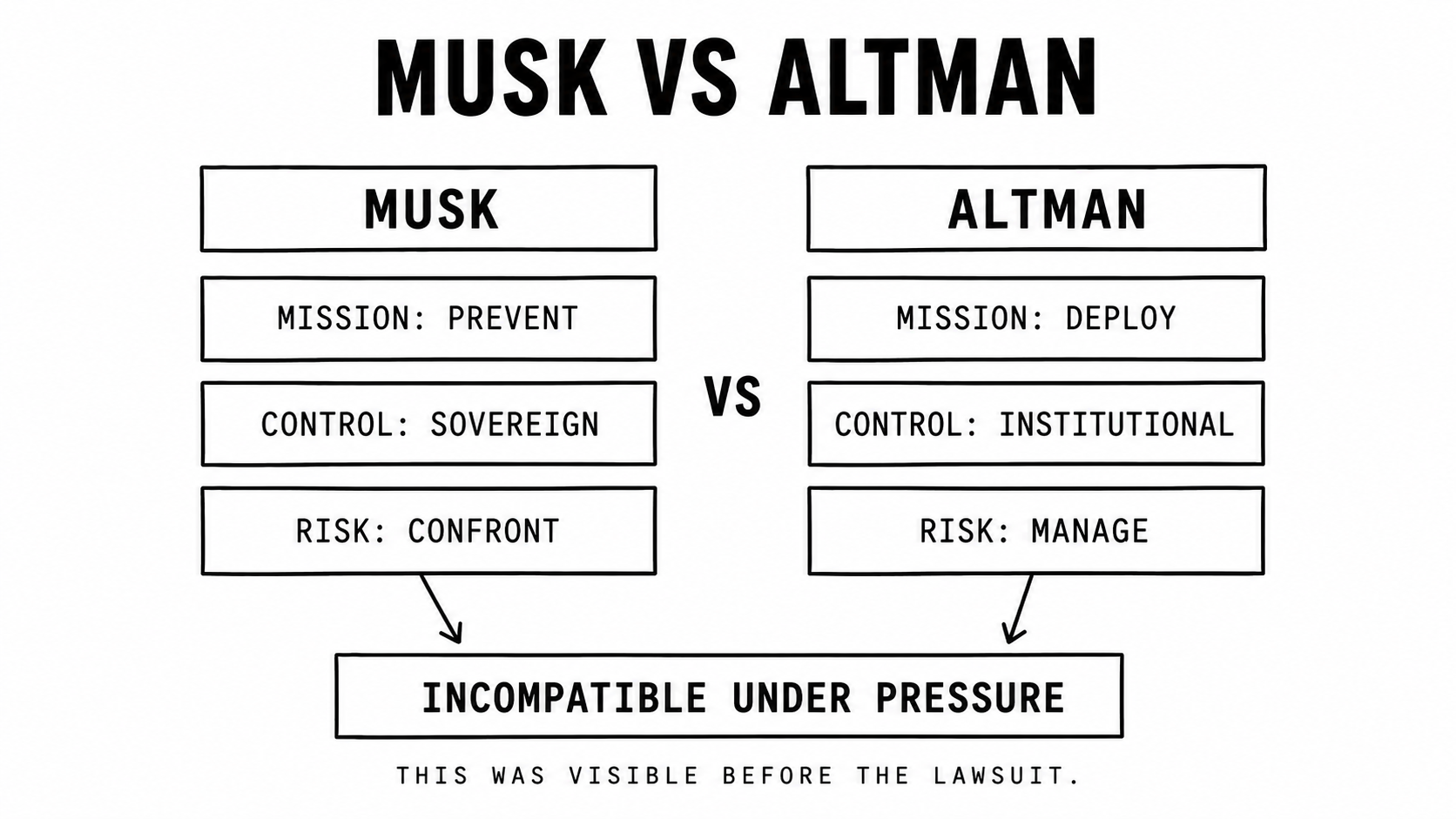
The Musk-Altman incompatibility has three identifiable dimensions.
Mission relationship. Musk’s orientation to OpenAI was existential-risk-driven and explicitly non-commercial, the company existed to prevent AI from destroying humanity, and commercialization was the threat. Altman’s orientation was deployment-first and scaling-optimized, the company existed to build and release powerful AI, and commercialization was the mechanism. These are not different strategies for the same goal. They are different goals wearing the same name.
Control style. Musk’s operating pattern across his companies is high-control, founder-sovereign, and resistant to governance structures that dilute decision authority. Altman’s operating pattern is consensus-building, board-mediated, and structured around institutional legitimacy. Two founders with these profiles cannot share a governance structure for long. One will leave or attempt to take control.
Risk philosophy. Musk’s relationship to risk is acceleration-through-confrontation, identify the existential threat, act on it at maximum speed, tolerate instability as the cost of urgency. Altman’s relationship to risk is managed-deployment, move fast within institutional constraints, build trust with regulators and partners, treat stability as a feature. These philosophies produce directly incompatible decisions at every major fork.
Why This Was Predictable
None of these variables are hidden. They are not revealed by the lawsuit. They are demonstrated in every public statement, funding decision, and structural choice both men made before OpenAI existed. The incompatibility was not latent, it was active and observable before the organization was founded.
The diagnosis that was missing was not information. It was a framework capable of naming the structural conflict precisely enough to act on it. “These two people have different visions” is not actionable. “These two founders have incompatible mission relationships, opposing control styles, and conflicting risk philosophies, and their profiles predict irreconcilable divergence under commercial pressure” is.
That is the difference between a personality read and an identity diagnostic.
What the Diagnostic Does
SIM95 is built for exactly this. Not to predict whether founders will like each other, that is the wrong question. To surface the structural identity dimensions that determine whether two people can build the same thing under pressure: their relationship to mission and control, their collapse signatures under stress, their decision pace and boundary architecture, their operating mode when the environment forces a choice between institutional legitimacy and personal conviction.
A pre-engagement diagnostic run on both founders in 2015 would not have told them to walk away. It would have named the specific pressure points, mission commercialization, governance authority, risk tolerance under deployment pressure, where their structural differences were guaranteed to produce irreconcilable decisions. What they did with that information would have been their choice.
Instead, $1 billion in commitments were made, a decade of acrimony accumulated, and the incompatibility is now being litigated in federal court for $130 billion.
The trial is not the story. The story is what the trial costs when the diagnostic never happens. For program operators, accelerators, and institutional investors who build rooms of founders under pressure, the Musk-Altman incompatibility is not an edge case. It is the category of failure that pre-engagement identity screening exists to surface. Not to eliminate the risk. To name it before the commitments are made.